While transgressions offensive to the left often include voicing unpopular political opinions, they can also include simple bad timing even when expressing locally popular opinions. For instance, on Oct. 8 at Scripps College, there was an anti-Kavanaugh protest scheduled for noon. But then the organizers realized that the same day was Indigenous People’s Day at Scripps. They promptly rescheduled the protest and apologized: “We want to deeply apologize for scheduling this event on the same day as the 2nd annual Indigenous People’s Day. Monday is a day for indigenous and non-indigenous allies to stand in solidarity and acknowledge the genocidal mission system that enslaved and killed 80% of Natives living on this land.”
Of course, there is nothing inherently wrong with apologies, or apologies in a political context. After all it’s eminently reasonable to apologize for acts that are objectively offensive to people regardless of political affiliation. Consider, for instance, the recent apology by Michigan Republican U.S. Senate candidate John James after one of his campaign ads inadvertently included an image of a swastika pinned to a bulletin board in a hallway scene captured by the camera. James stated, “We should have caught this error, and we didn’t, and there’s no excuse. I’m responsible for everything that our team does and fails to do, and I will do everything in my power to make sure this never, ever happens again.” James’ apology seemed heartfelt, uncoerced, and apolitical, despite being issued during a campaign for elected office.
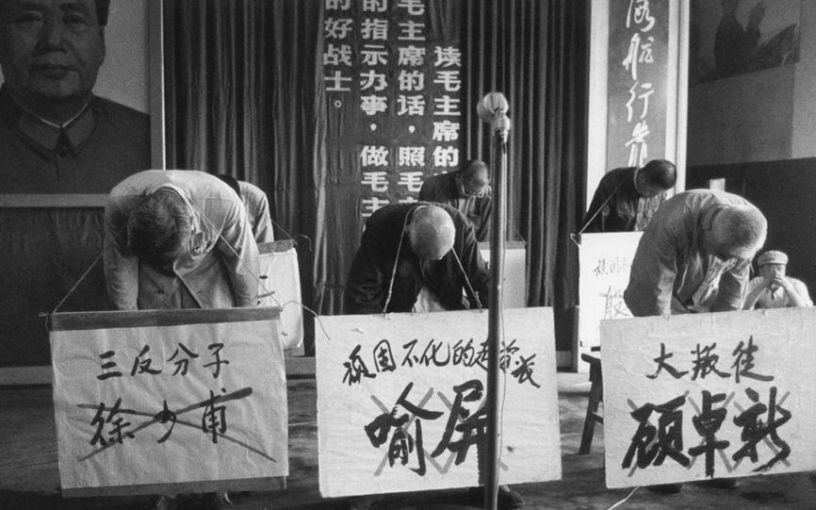
However, the emergence of the ritualized apology as the mechanism to prevent a loss of favor with the political left is an entirely different phenomenon—and one that is rapidly becoming a powerful tool to shape behavior in ways that are amplifying the leftward pull among progressives. The common thread in each case is a familiar sequence that begins with an unpopular or poorly timed statement or action that spurs a rapidly growing wave of objections. Offenders are ostracized, accompanied by the unspoken question of whether they will be completely cast out of the social group or whether they can redeem themselves in a way that brings them back into the fold. This is where ritualized apologies come in: Unpopular political opinions or poorly timed statements that go against a certain set of political beliefs now require restitution.
Under the unwritten rules that increasingly circumscribe discourse in academia, Silicon Valley, and beyond (some of which we’ve described here), there is never an acceptable manner or moment to express certain opinions. The louder the objections, the more effusive the apology must be. And in addition to providing atonement, apologies also serve as a form of virtue signaling, both for those who demand them and those who issue them.
We tell our children to apologize when they break something. Yet, what does it mean when apologies are demanded as the price of expressing opinions that fall outside the narrow zone of permissibility defined by the loudest voices in the room? The inevitable result is an increase in self-censorship.
