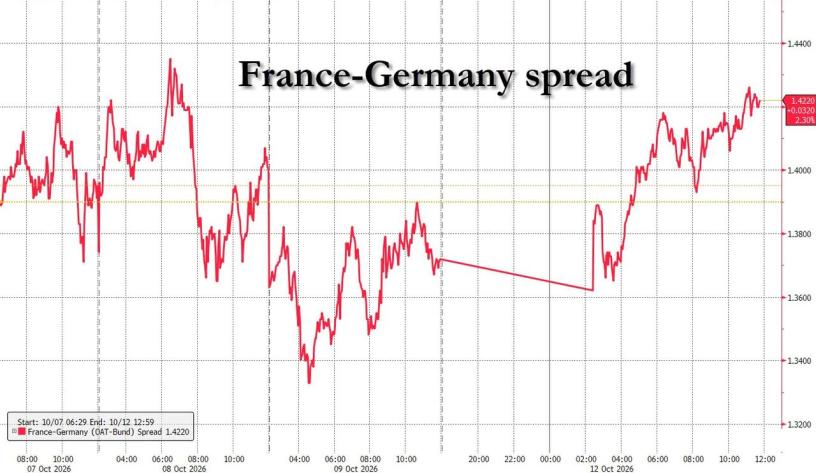
Europe Learns To Love Tariffs, Canada Learns What Happens When You Don’t By Benjamin Picton, senior market strategist at Rabobank US and European equity indices were firmly in the black on Friday as the recent run up in bond yields took a breather. The S&P500 closed 46 points higher at 7811 with strong gains across the real estate, consumer discretionary, healthcare and financial sectors. US 10-year yields were just over 1bp higher on the day, but down by almost 7bps over the course of the week with most of the decline in yields arriving on Thursday. The yield on French 10-year bonds fell by 4.2bps to close the week slightly lower. That helped to propel the CAC40 to a 0.95% gain on Friday, with Arcelor Mittal, Capgemini, L’Oreal, Hermes, and Renault among the most prolific gainers. Renault shares got a boost from news that the European Union will enact a 350,000 quota against imports of Chinese hybrid and plug-in hybrid vehicles, above which much steeper tariffs will kick in. For context, Chinese exports of hybrid cars into the European market have risen from approximately 300,000 in 2025 to an estimated 800,000 in 2026 according to the Financial Times. EU Trade Commissioner Maros Sefcovic expects the new safeguard measure to reduce Chinese imports by more than 50%. Importantly, the measures were agreed bilaterally with Beijing (thereby minimizing risk of retaliation) and do not require any evidence of market abuse to be enacted. Politico reported over the weekend that Germany would like Britain to raise tariffs on Chinese electric vehicles in exchange for preferential access to the European market amid a lingering sense on the continent that Britain should not be allowed to cherry-pick the benefits of EU membership. A desire to make Britons feel the consequences of emphasizing their own sovereignty above economic access in 2016 is particularly acute in France, where temptations toward nationalistic chest-thumping are perhaps encouraged by centuries of rivalry with Britain and the context of an impending Presidential election where populist candidates are expected to do well. The German quid-pro-quo for Britain sounds eerily reminiscent of the…Read More
Canada, Economy, Europe, News, Politics, US
Europe Learns To Love Tariffs, Canada Learns What Happens When You Don’t