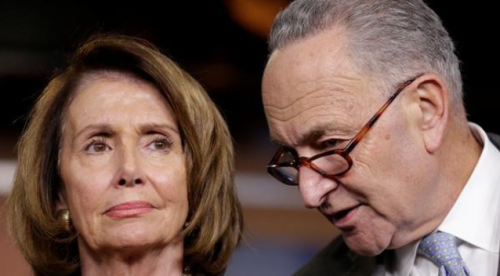
The U.S. House of Representatives on Tuesday launched an official impeachment investigation of President Donald Trump after he encouraged a foreign leader to conduct a probe that could damage a political rival.
House Speaker Nancy Pelosi, a Democrat, announced the investigation at a news conference, declaring “no one is above the law.”
There has been a groundswell of support among Democratic Party lawmakers for the move following Trump’s public admission that he asked Ukraine President Volodymyr Zelenskiy to investigate the son of presidential candidate and former Vice President Joe Biden.
Trump wrote on Twitter on Tuesday that the July 25 phone call was “very friendly and totally appropriate” and that he put “no pressure” on Zelenskiy. He later called the House probe “Witch Hunt Garbage” in a tweet.
The following explains how the impeachment process works.
WHY IMPEACHMENT?
The founders of the United States created the office of the presidency and feared its powers could be abused. So they included in the U.S. Constitution a procedure for removing a sitting president from office.
Under the Constitution, the president can be removed from office for “treason, bribery, or other high crimes and misdemeanors.”
What exactly that means is unclear. Historically, it can encompass corruption and other abuses of the public’s trust.
A president does not need to have violated a specific criminal law to have committed an impeachable offense.
Many legal commentators have said that pressuring a foreign leader to interfere in a U.S. election is the sort of conduct the nation’s founders would have considered an impeachable offense.
HOW DOES IT WORK?
A misconception about “impeachment” is that it refers to the removal of a president from office. In fact, impeachment refers only to the House, the lower chamber of Congress, bringing charges – similar to an indictment in a criminal case.
There is ongoing debate over how an impeachment investigation should begin. Doug Collins, the leading Republican on the Judiciary Committee, has argued that a formal impeachment investigation does not begin until the full House has voted to authorize it. But Democratic lawmakers have argued that such a vote is not necessary.
The House Judiciary Committee has historically led impeachment investigations, but Democratic Party leaders can also opt to put a select, handpicked committee in charge.
If a simple majority of the House’s 435 members approves bringing charges, known as “articles of impeachment,” the process moves to the Senate, the upper chamber, which holds a trial to determine the president’s guilt.
In such a trial, House members act as the prosecutors, the senators as jurors; the chief justice of the U.S. Supreme Court presides. A two-thirds majority vote is required in the 100-member Senate to convict and remove a president.
Lawmakers are not required to prove their case beyond a reasonable doubt — the evidentiary standard in a criminal case.